 Nightgap
How the sky score works
Every spot gets a score from 0 to 100 for each hour of the night. When enough good hours line up in a row, you get an alert. Here's what goes into that number.
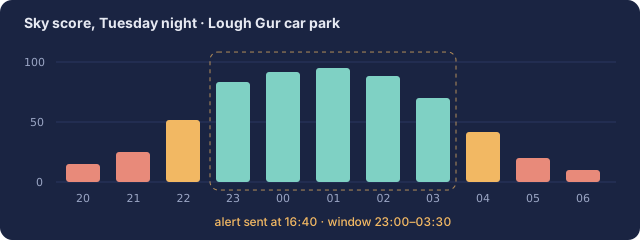
A real night from November: the window between 23:00 and 03:30 cleared 70 for four hours straight, so the alert went out at 16:40.
What goes in
Cloud cover by layer. We take the hourly forecast from public numerical weather models, split into low, mid and high cloud. Low cloud counts most: a deck of stratocumulus is the end of the night. High cloud counts less for planetary observers than for deep-sky ones.
Darkness. We calculate the Sun's depression below the horizon for each spot. Until it's 18° down, the sky isn't fully dark, and the score is capped accordingly.
The Moon. Phase and altitude together. A thin crescent low in the west barely matters; a gibbous moon at 40° washes out most of the sky.
Wind and dew. Strong gusts shake a long focal length, and a spot where the temperature is about to meet the dew point will fog the optics within the hour.
Your profile. When you add a spot you choose what you mostly observe: deep sky, Moon and planets, or wide-field photography. The weights change with it.
Reading the score
- 80+Go. Clear, dark, steady enough for anything you'd normally do.
- 65–79Good night with one compromise: some high cloud, a bit of moon or a breeze.
- 40–64Usable for the Moon, bright planets or a quick look. Probably not worth the drive.
- <40Stay in. Clean the eyepieces.
When an alert is sent
By default you get an email when a spot has at least three hours in a row scoring 65 or more, starting before 02:00. You can change both numbers for each spot: some people will happily drive an hour for 90 minutes of sky, some won't leave the garden for less than a whole night.
Alerts are checked against each new model run. The afternoon run decides whether the email goes out; later runs can only send a "called off" note, never a second "go" for the same night. We tried sending updates at 21:00 and people hated it.
What it can't do
The score is only as good as the forecast, and Irish cloud is hard to forecast. Small showers off the Atlantic and fog in river valleys are the two things that most often catch us out. Over the last winter, about four in five "go" alerts turned into a night members logged as good.
We don't predict seeing (atmospheric steadiness) for free plans. Supporters get a rough estimate based on the jet stream and the temperature profile, clearly labelled as rough.